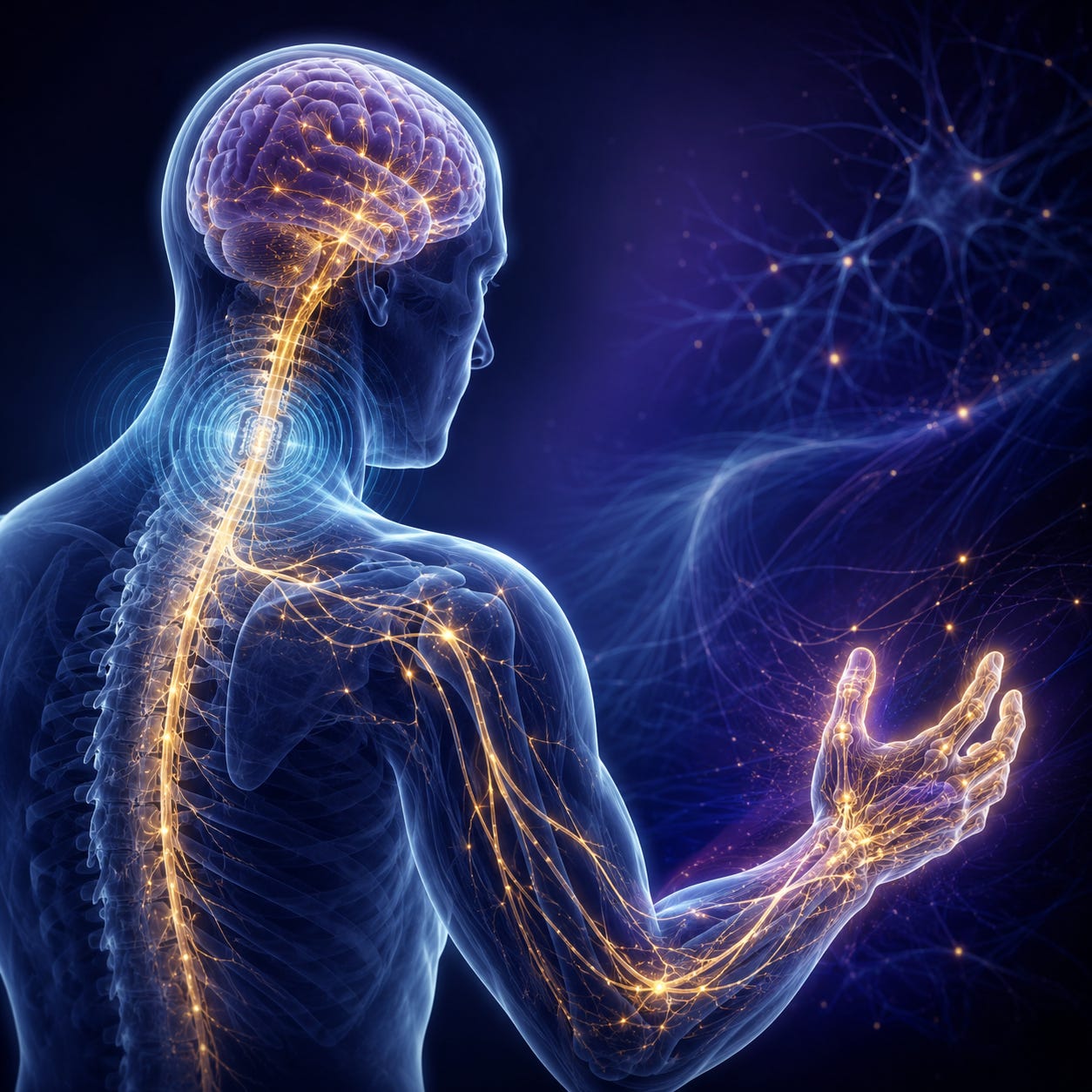
Stroke Arm Recovery May Improve With Spinal Cord Stimulation
Early research suggests cervical spinal cord stimulation may help some stroke survivors regain better arm and hand movement, but larger trials are still needed.
A small Nature Medicine feasibility trial found that cervical epidural spinal cord stimulation may improve arm and hand movement in people living with chronic post-stroke hemiparesis. Seven participants received temporary stimulation leads near the cervical spinal cord for four weeks.
When stimulation was turned on, motor function improved quickly, with average strength rising 32 percent and Fugl-Meyer Assessment scores improving by 5.6 points. No serious adverse events were reported, but this remains early research and not yet a routine clinical treatment.
Study Details
Arm and hand weakness after stroke can remain disabling for years. For many survivors, the problem is not only muscle weakness but also impaired signaling between the brain, spinal cord, and muscles. Even when some neural pathways remain, the signal may be too weak or poorly coordinated to support useful movement.
This study tested whether cervical spinal cord stimulation could act like an assistive neuroprosthetic. Instead of replacing rehabilitation, the goal was to make the remaining brain-to-spinal-cord connections work more effectively while the device was active.
The research team studied seven people with chronic post-stroke upper limb hemiparesis. Participants had significant motor deficits at baseline, with Fugl-Meyer Assessment scores in the severe range. The group included both ischemic and hemorrhagic stroke survivors, both men and women, and participants ranging from young adulthood to older middle age.
Methodology
Researchers implanted two temporary epidural stimulation leads on one side of the cervical spinal cord. This region of the spinal cord helps control the arm and hand. The device delivered electrical stimulation intended to activate sensory nerve fibers that feed into spinal motor circuits.
Participants were tested with stimulation off and stimulation on. Researchers measured strength, arm movement, hand and finger function, spasticity, and Fugl-Meyer Assessment scores. The Fugl-Meyer Assessment is a standard clinical tool used to measure motor recovery after stroke.
The study lasted four weeks. Importantly, this was a small, open-label feasibility trial. That means everyone knew they were receiving stimulation, and there was no placebo or sham stimulation control group. The main goals were safety, feasibility, and early signals of benefit, not definitive proof of effectiveness.
Key Findings
Motor gains appeared quickly when stimulation was turned on. Average strength increased by 32 percent, and Fugl-Meyer Assessment scores improved by 5.6 points during stimulation.
At the end of four weeks, participants had an average 6.6-point improvement in Fugl-Meyer Assessment scores compared with baseline.
Spasticity decreased in all seven participants, suggesting stimulation may affect both weakness and abnormal muscle tone.
Three of seven participants with residual corticospinal connectivity to finger muscles showed improvement in hand or finger movement.
No moderate or serious adverse events were reported. There were 14 mild adverse events that resolved without lasting effects.
One participant experienced shortness of breath when stimulation reached a cervical level near C3 to C4. The event resolved immediately after stopping stimulation, and the protocol was changed to avoid the highest cervical stimulation levels.
Implications for Practice
For stroke survivors, the most important message is cautious hope. This study suggests that some people with long-standing arm and hand weakness may still have usable neural pathways that can be amplified by spinal cord stimulation. That matters because many patients are told that recovery potential becomes very limited years after stroke.
For clinicians, this study is important because it frames cervical spinal cord stimulation as an assistive technology, not just a rehabilitation enhancer. When the device was on, movement improved immediately. That differs from treatments designed mainly to promote long-term neuroplasticity through repeated therapy sessions.
This distinction also separates it from FDA-approved paired vagus nerve stimulation, such as Vivistim, which is used alongside rehabilitation therapy for chronic ischemic stroke patients with moderate to severe arm impairment. Cervical spinal cord stimulation for post-stroke upper limb recovery is still investigational.
The practical clinical question now is patient selection. The early signal suggests that people with preserved sensory function or residual corticospinal connections may respond better. Future studies will need to clarify who benefits, how durable the effects are, how much therapy should be paired with stimulation, and whether a fully implantable system can be used safely in daily life.
For now, patients should not view this as an available standard treatment. It is a research-stage approach best discussed with a neurologist, physiatrist, rehabilitation medicine specialist, or stroke recovery center, especially if clinical trial participation is an option.
Why This Matters
Stroke recovery is often discussed as a race against time, with the greatest progress expected in the first months. This study challenges that mindset without dismissing the limits of early evidence. It suggests that in some chronic stroke survivors, the motor system may still contain dormant capacity that can be unlocked when spinal circuits are electrically supported.
The next phase of research will be critical. A larger study using a fully implantable system will need to show whether these benefits can be reproduced, sustained, and translated into real daily function such as reaching, grasping, dressing, cooking, and personal care.


Where was this study done? Are there further studies?
Are all rehab sites in the U.S. and in Canada using the Vagus nerve treatment?
If that method is so good, what amount of improvement is being seen with vagus nerve treatment in stroke patients?