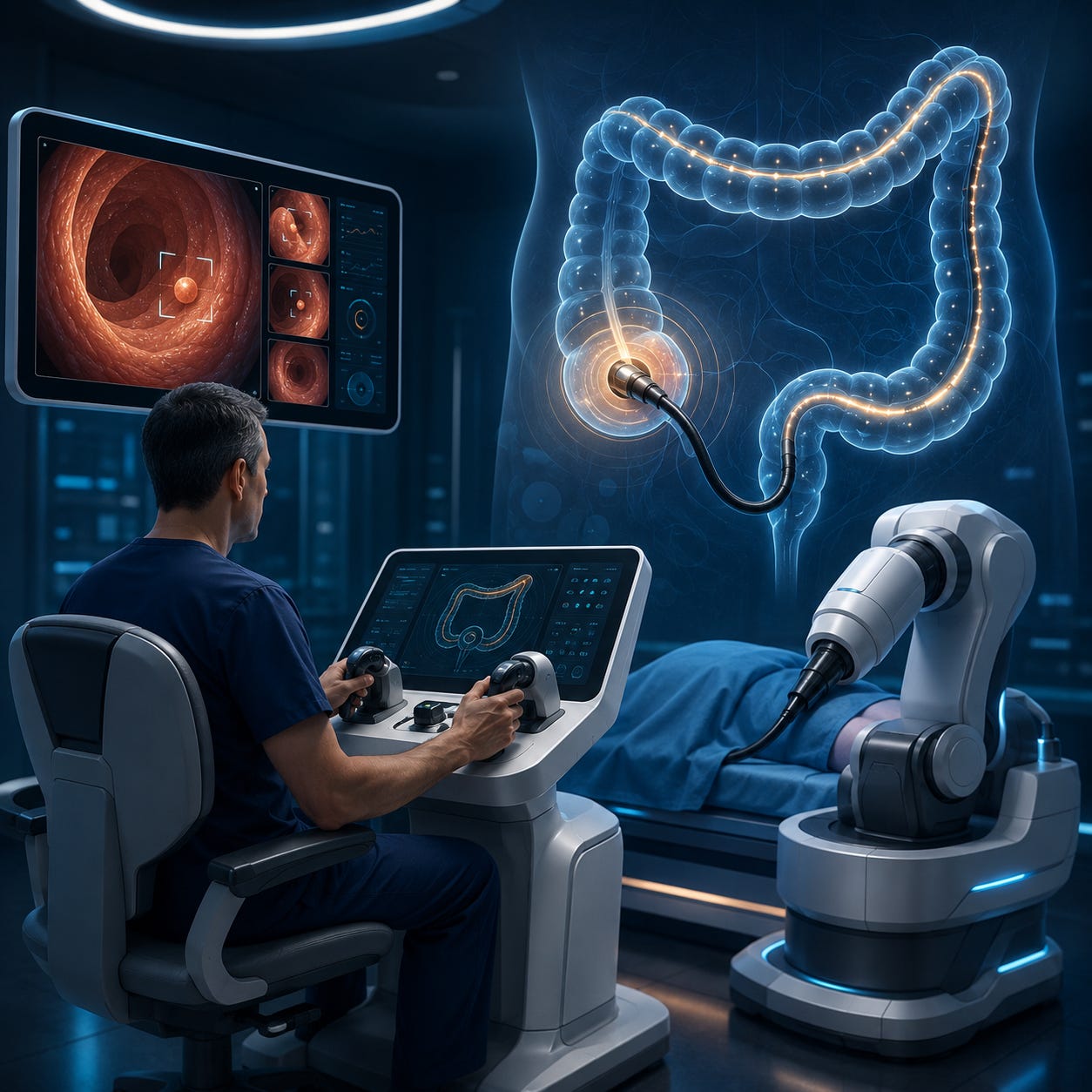
Robotic Colonoscopy Moves Closer to Clinical Use
A first-in-human study of the Triton robotic colonoscopy system moving ahead to clinical use
A new first-in-human CARE study suggests that robotic colonoscopy may be technically feasible and safe in carefully selected patients. The Triton robotic colonoscopy system achieved 100% cecal intubation in 50 patients, detected polyps at rates comparable to manual colonoscopy, and allowed successful removal of eligible polyps, while potentially reducing the physical burden on endoscopists.
The system is still moving through the regulatory process, so this is not yet a routine clinical option.
Study Details
Colonoscopy remains one of the most important tools for colorectal cancer screening, polyp detection, and early cancer prevention. But the procedure is physically demanding for gastroenterologists and requires substantial training to perform consistently and safely.
The Triton robotic colonoscopy system, developed by Neptune Medical, is designed to replicate the full colonoscopy workflow. Unlike robotic systems that only assist with advanced therapeutic procedures, Triton aims to support insertion, navigation to the cecum, ileum entry, polyp detection, and polypectomy.
The CARE study was presented at Digestive Disease Week 2026. It was a prospective, first-in-human trial involving 50 patients. The study was funded by Neptune Medical.
Methodology
The study was single-arm, nonrandomized, and conducted at one site. Three experienced endoscopists performed the procedures.
The trial had two phases. Phase A included 10 patients and focused on safety. Patients first underwent manual colonoscopy, followed by robotic colonoscopy, without polypectomy. Researchers watched for major adverse events such as perforation, bleeding, hospitalization within 48 hours, and delayed bleeding or perforation within 14 days.
Phase B included 40 patients and tested robotic colonoscopy alone. In this phase, the robotic system was used not only to complete the colonoscopy but also to remove polyps smaller than 2 cm. Researchers measured completion rates, adverse events, polyp detection, adenoma detection, time to reach the cecum, mucosal injury, and endoscopist workload.
Key Findings
The robotic system achieved 100% cecal intubation in both phases of the study.
There were no major adverse events reported in either phase.
All procedures were completed with patients in the left-lateral position, without repositioning, abdominal pressure, or conversion to manual colonoscopy.
In Phase B, researchers detected 79 polyps, with an adenoma detection rate of 54.2% and a polyp detection rate of 67.5%.
The system successfully removed 75 polyps across the 50 patients. Two lesions larger than 2 cm were not removed because the study protocol excluded them.
The median time to reach the cecum was 13 minutes, with a range of 5 to 36 minutes.
Reported mucosal injuries were limited, with no grade 4 or higher injuries and no intervention required.
Implications for Practice
For patients, the most important message is that robotic colonoscopy is not replacing standard colonoscopy today. But this early study suggests that robotics could eventually make colonoscopy more consistent, more ergonomic for physicians, and potentially easier to scale across health systems.
For healthcare providers, the technology is worth watching for three reasons. First, the 100% cecal intubation rate in this small early trial is encouraging. Second, the polyp and adenoma detection results appear comparable to manual colonoscopy in this setting. Third, the ergonomic benefit may matter in a field where endoscopists often perform repetitive, physically demanding procedures throughout the day.
The major unanswered questions are cost, regulatory clearance, broader real-world performance, and whether less experienced endoscopists can safely achieve proficiency faster with robotic assistance. Larger, multicenter, comparative studies will be needed before this becomes part of routine screening practice.