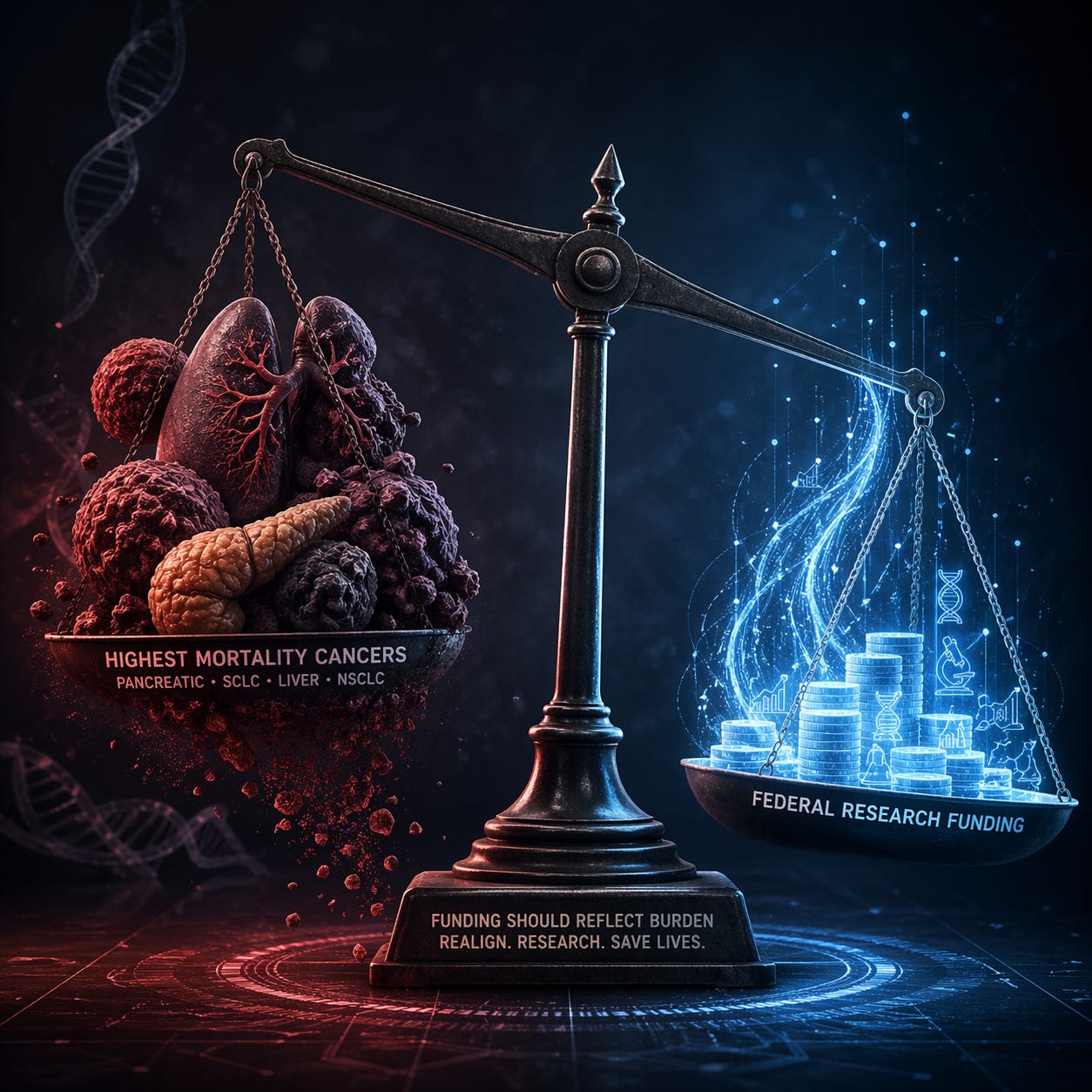
Deadliest cancers funding gap revealed
Research shows lethal cancers receive less support despite higher mortality burden
A new analysis suggests that cancers with the highest death rates, such as small-cell lung cancer and pancreatic cancer, receive significantly less federal funding per death compared with cancers that have better survival outcomes.
Study Details
A recent study from the National Cancer Institute examined how federal research funding is distributed across different cancer types in the United States. The goal was to assess whether funding aligns with disease severity, particularly mortality.
The analysis focused on cancers such as small-cell lung cancer (SCLC), pancreatic cancer, liver cancer, and non–small cell lung cancer (NSCLC), all of which carry high mortality risks. These were compared against cancers like breast and prostate cancer, which generally have better survival outcomes.
The findings highlight a persistent mismatch between disease burden and funding allocation.
Methodology
Researchers combined multiple national datasets to build a comprehensive view:
Cancer incidence and survival data from SEER registries (2015 to 2021)
Additional cancer statistics from North American cancer registries (2022)
National Institutes of Health funding data for 2025
They calculated key metrics such as mortality-to-incidence ratios (MIRs), funding per case, and funding per death. This allowed comparison of how resources are distributed relative to how deadly each cancer is.
Key Findings
Highest lethality, lowest funding: SCLC and pancreatic cancer had the highest mortality rates but received among the lowest funding per death
Funding imbalance: Breast cancer received about $69,800 per death and prostate cancer about $126,992, compared with just $2,818 for SCLC
NSCLC gap: Despite being common and deadly, NSCLC had one of the lowest funding-per-death figures
Survival contrast: Survival rates ranged from about 9% for SCLC to nearly 98% for prostate cancer
Systemic pattern: Funding appears more aligned with historical advocacy and incidence rather than mortality burden
Implications for Practice
For patients:
This study may help explain why progress in certain cancers feels slower. Lower funding can translate into fewer clinical trials, fewer new therapies, and delayed innovation in the cancers that need it most.
For healthcare providers:
Clinicians should be aware that disparities in research investment may influence treatment options and pipeline development. Advocacy for patients with high-mortality cancers may play a role in shaping future funding priorities.
For health systems and policymakers:
A shift toward funding models that incorporate mortality, quality of life impact, and societal burden could improve outcomes over time. Aligning investment with disease severity may accelerate breakthroughs where they are most urgently needed.