

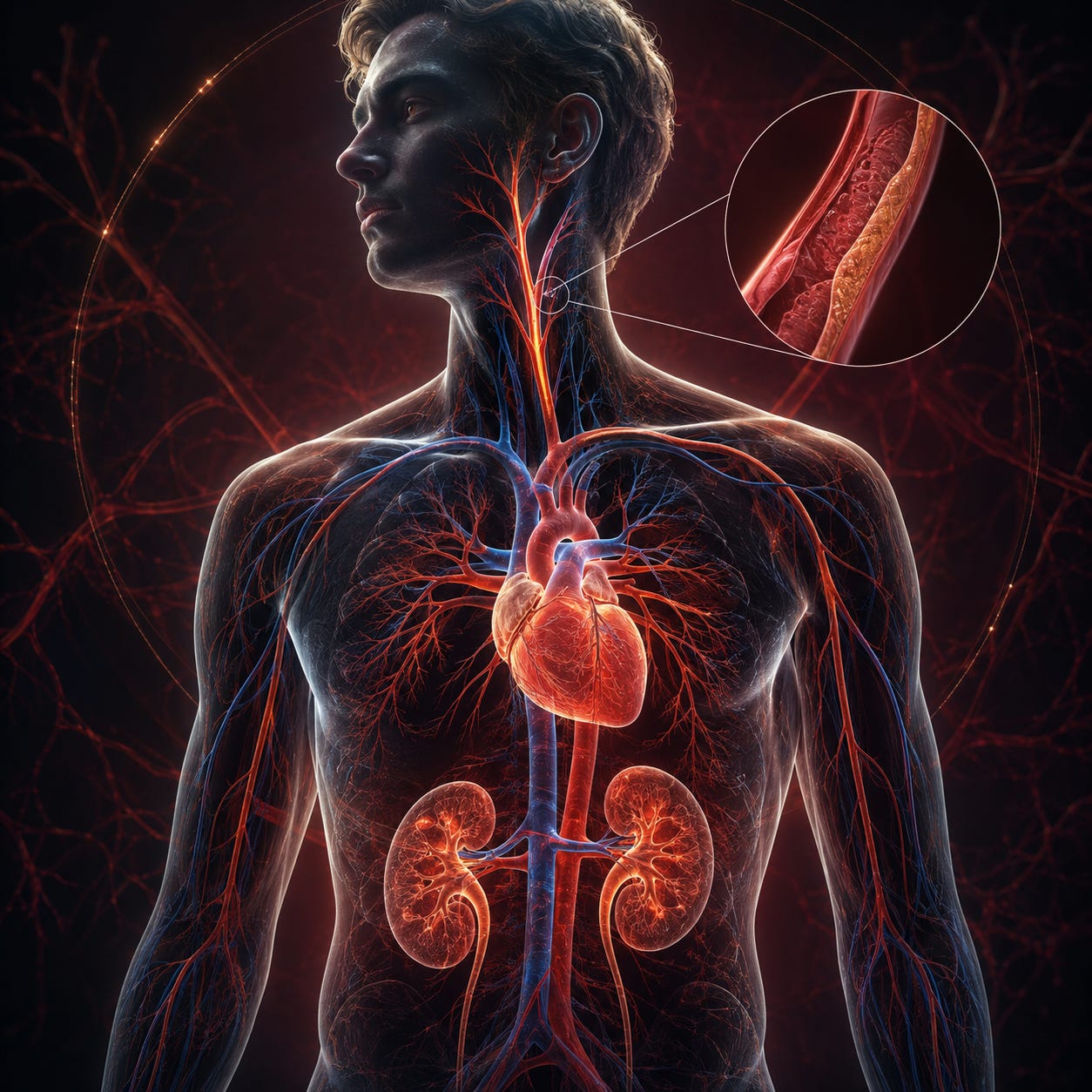
Cardiovascular disease may begin taking shape much earlier than many people realize. In a cohort of 1,283 young adults with an average age of 22.9 years, only 20.7% had no cardiovascular-kidney-metabolic risk factors.
Higher stages of cardiovascular-kidney-metabolic syndrome were also associated with poorer overall cardiovascular health and measurable thickening of the carotid artery wall, an early marker of arterial injury.
The findings do not prove that these young adults will develop heart or kidney disease. They do suggest that waiting until middle age to assess cardiovascular risk may miss an important prevention window.
Understanding Cardiovascular-Kidney-Metabolic Syndrome
Cardiovascular-kidney-metabolic syndrome, commonly called CKM syndrome, describes the close relationship among heart disease, kidney disease, obesity, and metabolic disorders such as diabetes.
These conditions are often treated separately. In practice, they can reinforce one another. Excess body fat can worsen insulin resistance and blood pressure. Diabetes and hypertension can damage the kidneys. Declining kidney function can then further increase cardiovascular risk.
The American Heart Association created the CKM staging framework to help clinicians recognize this progression earlier.
Stage 0 indicates no identifiable CKM risk factors. Stage 1 generally reflects excess or dysfunctional body fat. Stage 2 includes metabolic risk factors or kidney disease. Stage 3 represents subclinical cardiovascular disease or advanced kidney disease, before a major cardiovascular event has occurred.
Study Details
Researchers analyzed participants in the Future of Families Cardiovascular Health Among Young Adults study. The participants had originally been enrolled at birth between 1998 and 2000 across 20 large US cities.
The analysis included 1,283 participants who completed an in-person examination and health questionnaire in their early 20s. Their mean age was 22.9 years, and 54.4% were women.
Researchers classified each participant using the CKM staging system and evaluated cardiovascular health using the American Heart Association’s Life’s Essential 8 framework.
Life’s Essential 8 measures diet, physical activity, sleep, nicotine exposure, body mass index, blood glucose, cholesterol, and blood pressure.
The investigators also measured carotid intima-media thickness. This ultrasound measurement assesses the wall of the carotid artery in the neck and can reveal early arterial changes before symptoms appear.
Key Findings
Only 20.7% of participants were in CKM stage 0, meaning they had no identified CKM risk factors.
About 40.2% were in stage 1, primarily reflecting excess or dysfunctional body fat.
Another 36.2% were in stage 2, indicating metabolic risk factors or kidney disease.
Approximately 2.8% had reached stage 3, which includes subclinical cardiovascular disease or advanced kidney disease.
Average Life’s Essential 8 scores declined from 77.6 in stage 0 to 70.0 in stage 1 and 63.8 in stage 2.
Compared with stage 0, carotid artery walls were 0.014 mm thicker in stage 1, 0.020 mm thicker in stage 2, and 0.100 mm thicker in stage 3.
Body mass index, glucose, cholesterol, and blood pressure measures worsened as CKM stage increased.
What This Means for Young Adults
A person can feel healthy in their 20s while already developing the conditions that contribute to future heart, kidney, and metabolic disease.
CKM stage 1 does not mean that someone has clinical heart disease. It signals that the biological pathway toward disease may already be forming. At this stage, prevention may still have considerable value.
Young adults should know their blood pressure, cholesterol, blood glucose, weight trend, and family history. Kidney assessment may also be appropriate when obesity, diabetes, hypertension, or other risk factors are present.
Lifestyle remains important, including nutritious food, physical activity, adequate sleep, and avoiding nicotine. However, these findings should not be reduced to personal choices alone. Food access, neighborhood conditions, healthcare access, chronic stress, and economic instability can all influence CKM health.
Implications for Clinical Practice
Preventive care for young adults often receives less attention once pediatric visits end. Many patients in their 20s interact with the healthcare system only for acute problems, reproductive care, or employment requirements.
The CKM framework may help primary care clinicians use those encounters more effectively.
For patients in stage 0, current guidance recommends checking lipids, blood glucose, and kidney function at least every five years. Suggested monitoring increases to every two to three years in stage 1 and annually in stages 2 and 3.
Clinicians should avoid presenting CKM staging as a fixed prediction. Its value lies in identifying modifiable risk early and connecting findings across organ systems.
A young adult with obesity, elevated blood pressure, abnormal glucose, or early kidney dysfunction should not have each result considered in isolation. Together, these findings may represent a developing cardiovascular risk pathway that deserves coordinated management.
Important Limitations
This was an observational analysis, so it cannot establish that a higher CKM stage caused the arterial differences.
The cohort also included a large proportion of participants from disadvantaged urban backgrounds. That makes the study valuable for examining a frequently underrepresented population, but the results may not apply equally to every group of young adults.
Several health behaviors were self-reported, which may have limited the accuracy of the diet, exercise, sleep, and nicotine measurements.
Longer follow-up will be needed to determine how strongly CKM stage in the early 20s predicts later heart attacks, strokes, kidney failure, and other clinical outcomes.
The Bottom Line
Cardiovascular prevention should not begin only after middle age.
In this cohort, nearly four in five young adults had already reached at least CKM stage 1. Higher stages were associated with worse cardiovascular health and early arterial injury.
For patients, the practical message is to learn your numbers early. For clinicians, it is to treat obesity, metabolic health, kidney function, and cardiovascular risk as parts of the same system.