
Aspirin Alone Prevented Clots After Joint Replacement
A large randomized trial found low-dose aspirin matched a rivaroxaban-first regimen for standard-risk patients after hip or knee replacement.

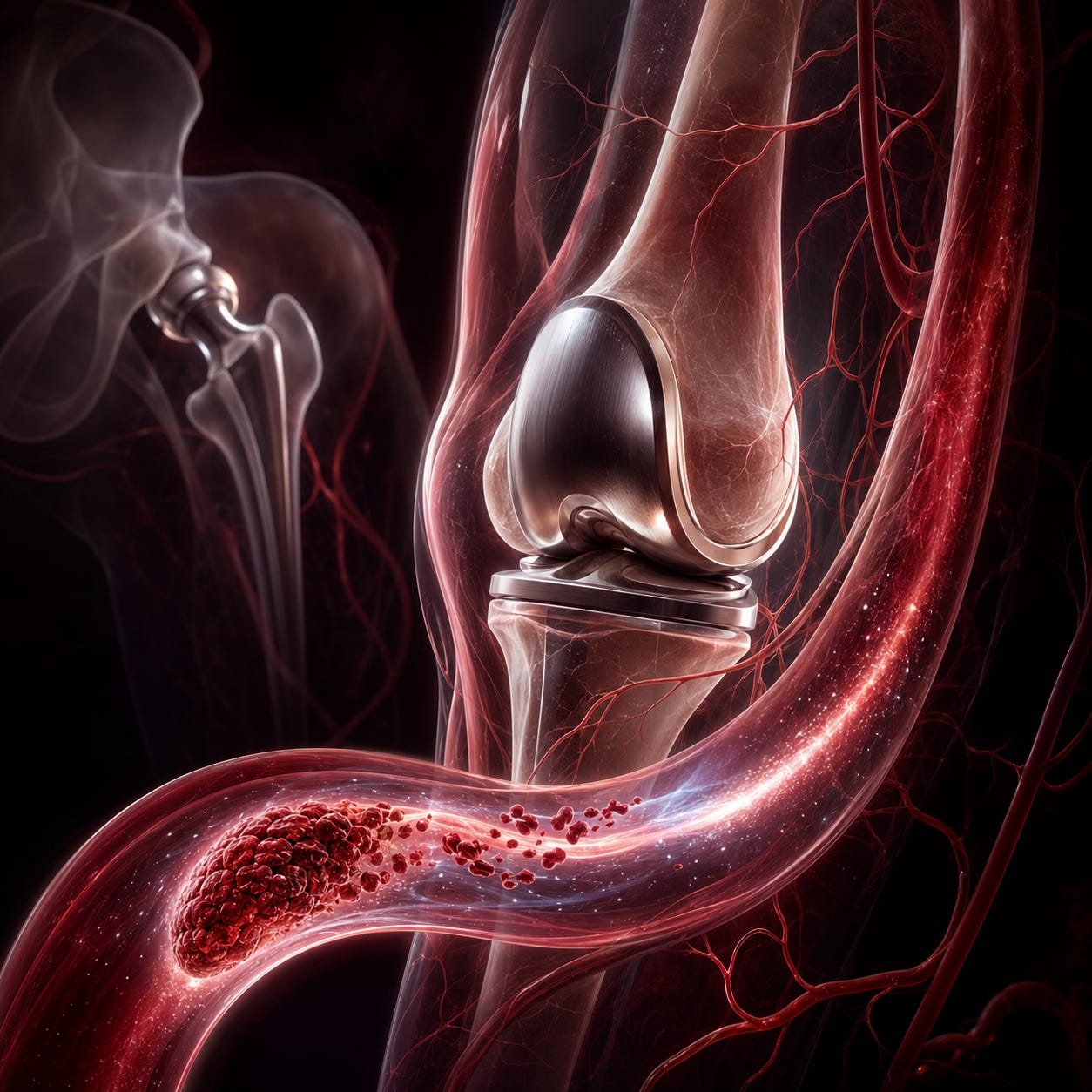
For many patients at standard risk of blood clots, taking 81 mg of aspirin alone after hip or knee replacement may prevent symptomatic venous thromboembolism as effectively as beginning with five days of rivaroxaban and then switching to aspirin. Bleeding rates were also similar.
The findings could simplify recovery and reduce medication costs, but they should not be extended automatically to patients with previous blood clots, metastatic cancer, recent lower-limb fractures, or other major risk factors.
Why clot prevention matters after joint surgery
Hip and knee replacement temporarily increase the risk of deep vein thrombosis, in which a clot develops in a deep vein, usually in the leg. A clot can also travel to the lungs and cause a potentially life-threatening pulmonary embolism.
Preventive treatment after surgery commonly includes a direct oral anticoagulant such as rivaroxaban, low-molecular-weight heparin, or aspirin. The best choice has remained controversial because clinicians must balance clot prevention against bleeding, cost, convenience, and each patient’s individual risk.
The earlier EPCAT II trial established that patients could receive rivaroxaban for five days and then switch to aspirin. EPCAT III asked the more consequential question: Do standard-risk patients need rivaroxaban at all?
Study details
The EPCAT III trial, published in The New England Journal of Medicine, included 5,429 patients undergoing primary or revision hip or knee arthroplasty at 15 Canadian academic health centers.
Participants had an average age of 66.5 years, and nearly 57% were men. Just over half underwent knee replacement, while most of the remaining participants underwent hip replacement. Primary procedures represented 96.6% of the operations.
Importantly, this was predominantly a standard-risk population. Only 3.4% of participants were classified as being at high risk for venous thromboembolism. People with previous venous thromboembolism, metastatic cancer, or a recent hip or lower-limb fracture were excluded.
Methodology
Participants were randomly assigned to one of two once-daily regimens immediately after surgery:
Aspirin 81 mg for the first five days
Rivaroxaban 10 mg for the first five days
After day five, everyone received aspirin 81 mg daily. Treatment continued for another nine days following knee replacement and another 30 days following hip replacement.
The double-blind trial followed patients for 90 days. Its primary effectiveness outcome was symptomatic proximal deep vein thrombosis or pulmonary embolism. Researchers also monitored major bleeding and clinically relevant nonmajor bleeding.
The study was designed as a noninferiority trial. This means it tested whether aspirin was not unacceptably worse than the rivaroxaban-first strategy within a predefined margin. It was not designed to prove that the treatments were identical.
Key findings
Symptomatic venous thromboembolism occurred in 0.48% of patients receiving aspirin alone and 0.45% of those receiving rivaroxaban followed by aspirin.
Aspirin met the trial’s statistical requirement for noninferiority, with a risk difference of 0.02 percentage points and a 95% confidence interval from -0.34 to 0.39.
Major or clinically relevant nonmajor bleeding occurred in 1.66% of the aspirin group and 2.04% of the rivaroxaban-first group. The difference was not considered clinically meaningful.
When distal deep vein thrombosis was added to the effectiveness outcome, event rates remained similar at 1.03% with aspirin and 0.87% with rivaroxaban followed by aspirin.
Overall clot rates were low in both groups, reinforcing that the findings apply most directly to carefully selected patients receiving contemporary surgical care.
Why the findings matter
Aspirin is inexpensive, widely available, familiar to patients, and easier to manage than many anticoagulants. Avoiding an initial direct oral anticoagulant could simplify discharge planning and reduce out-of-pocket medication costs.
EPCAT III also advances the evidence beyond EPCAT II. The earlier trial supported switching to aspirin after five days of rivaroxaban. The new trial suggests that many standard-risk patients may be able to begin with aspirin immediately after surgery.
This does not mean aspirin is universally superior, nor does it prove that anticoagulants are unnecessary after every joint replacement. It provides stronger evidence for a risk-based approach.
Reconciling EPCAT III with earlier concerns
The findings may appear to conflict with the 2022 CRISTAL trial, which found more symptomatic venous thromboembolism with aspirin than with enoxaparin. That difference was driven largely by distal deep vein thrombosis, and CRISTAL was stopped early.
EPCAT III used a different comparator, study design, patient population, and outcome framework. Its expanded analysis, which included distal clots, did not identify a meaningful disadvantage with aspirin.
The studies should therefore be interpreted together, not treated as interchangeable. The total evidence supports careful patient selection rather than one universal regimen.
Implications for patients
Patients at standard risk may now have stronger grounds to discuss an aspirin-only strategy with their surgeon. The potential benefits include lower cost, simpler treatment, and avoidance of a separate anticoagulant prescription.
Patients should not begin or substitute aspirin without medical guidance. Aspirin can still cause surgical-site or gastrointestinal bleeding and may interact with other medications. The exact dose and duration used in EPCAT III are also important and should not be replaced with an improvised regimen.
Anyone recovering from joint replacement should seek urgent medical attention for new leg swelling, calf pain, unexplained shortness of breath, chest pain, coughing blood, fainting, or unusually heavy bleeding.
Implications for healthcare providers
EPCAT III provides high-quality randomized evidence supporting aspirin monotherapy for postoperative prophylaxis in appropriately selected, standard-risk arthroplasty patients.
The results may support simplified institutional protocols, but risk stratification remains essential. Previous venous thromboembolism, active or metastatic cancer, recent fracture, thrombophilia, prolonged immobility, and other clinical factors may justify a more intensive anticoagulation strategy.
The most reasonable practice change is not “aspirin for everyone.” It is greater confidence in aspirin for patients whose clotting and bleeding risks have been assessed and who resemble the population enrolled in EPCAT III.