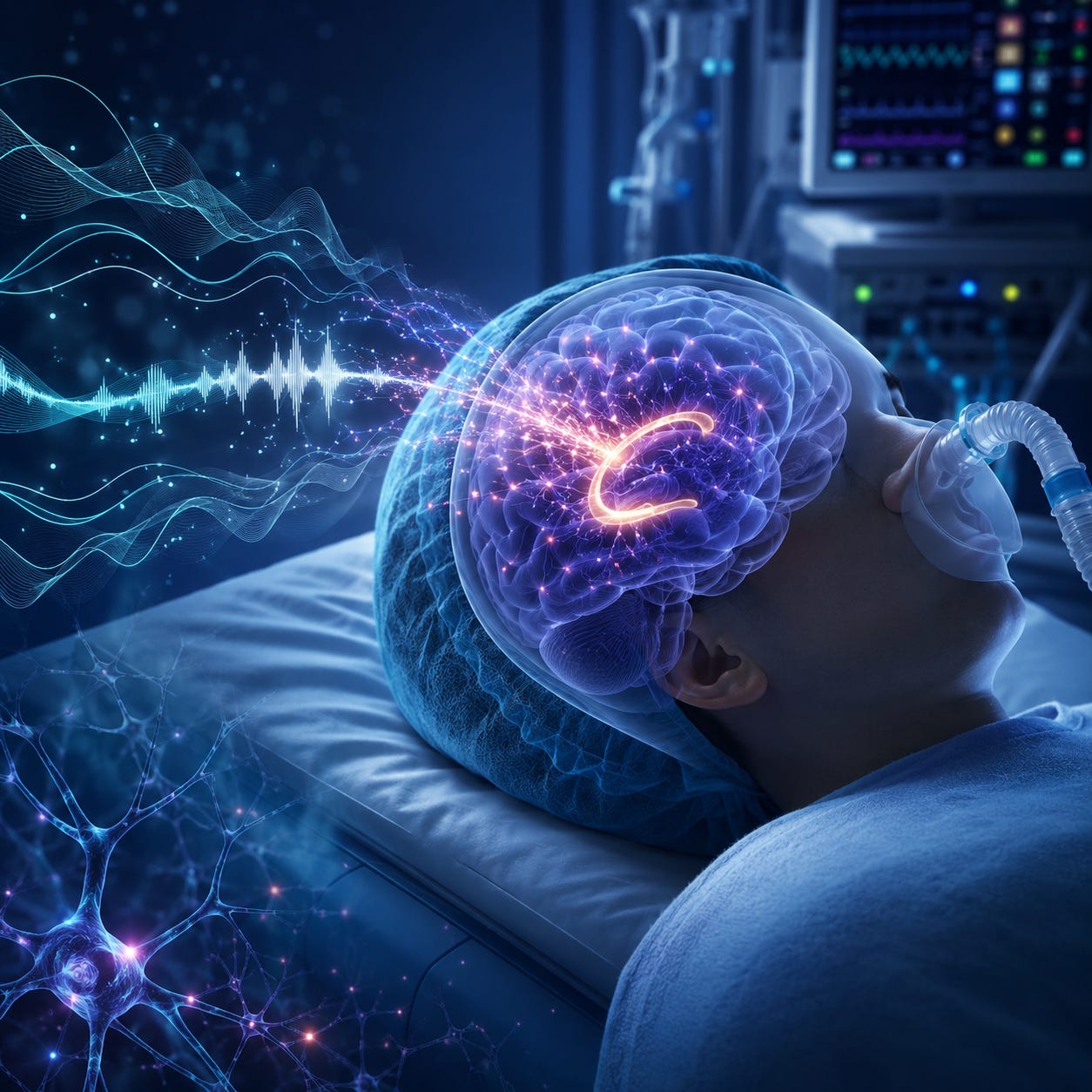
Anesthesia Brain Activity Study Reveals Hidden Listening
A small human neuroscience study suggests the brain may still process sounds and language during general anesthesia, even without conscious memory.
A new study found that the hippocampus, a brain region involved in memory and learning, showed signs of sound pattern recognition and language processing in patients under general anesthesia. The finding does not mean patients were awake or aware during surgery. None of the seven patients reported explicit memory afterward. Instead, it suggests that parts of the unconscious brain may continue analyzing the outside world more than previously understood.
Study Details
General anesthesia is designed to produce unconsciousness, prevent pain, and block explicit memory of surgery. For years, the common assumption has been that higher-level brain processing is largely shut down during deep anesthesia.
This study challenges that simple view. Researchers studied seven adults undergoing epilepsy surgery, specifically anterior temporal lobectomy, where access to the hippocampus was possible during the operation. The patients had drug-resistant temporal lobe epilepsy and were under general anesthesia, mainly with propofol.
The research focused on whether the hippocampus could still process complex auditory information while the patient was unconscious. The hippocampus is not a primary hearing center. It is more commonly associated with memory, learning, and meaning-making, which makes the findings especially interesting for neurologists, anesthesiologists, neurosurgeons, and consciousness researchers.
Methodology
Researchers used high-density Neuropixels probes to record activity from individual neurons and local brain signals in the hippocampus during surgery.
After a short baseline recording, patients were exposed to sounds for up to about 30 minutes. Three patients heard simple tones, including occasional “oddball” tones that were slightly higher or lower in pitch. Four patients heard spoken stories from “The Moth” podcast.
The team then analyzed whether hippocampal activity changed in response to sound patterns, speech structure, and word meaning. They compared some findings with data from awake epilepsy patients performing a similar task.
Key Findings
The hippocampus responded to unexpected tones while patients were under general anesthesia, suggesting some level of pattern detection.
Responses to oddball tones became more distinct over time, which may indicate a form of neural plasticity during unconsciousness.
In patients who heard podcast stories, brain activity reflected differences in parts of speech such as nouns and verbs.
Neural responses appeared related to how surprising a word was in context, suggesting the unconscious brain may still track aspects of language prediction.
None of the patients reported explicit memory of the sounds or stories after surgery, which supports the distinction between unconscious processing and conscious awareness.
Implications for Practice
For patients, the key message is reassuring but fascinating: this study does not show that people are awake during surgery. It does not show that patients consciously hear or remember conversations in the operating room. Instead, it suggests that the unconscious brain may still process some sensory information without forming normal conscious memories.
For healthcare providers, this research adds weight to a cautious and respectful operating room communication culture. Even if patients are deeply anesthetized, the possibility of residual sensory processing supports maintaining professional speech around patients during procedures.
For anesthesiology and neuroscience, the study raises important questions. Consciousness may not depend only on whether a single brain region is active. It may depend more on coordination across brain networks, global signal propagation, or recurrent processing across regions. The findings also may help explain prior reports of implicit recall after anesthesia, where patients do not consciously remember events but may show subtle traces of processing.
The study is small and highly specific. It involved seven epilepsy surgery patients, one brain region, and mainly propofol-based anesthesia. The results may not apply to sleep, coma, other anesthetics, or routine surgical patients without epilepsy. More research is needed before this changes anesthesia practice guidelines.